Sunday, 1 December 2024

When my dad came home


 Dear Reader,


I have had a chest infection, antibiotics which I very badly reacted to and a feeling of burning in my hands.  All very unpleasant.  I saw that Queen Camilla had had a chest infection and that she thought it was not easy to get rid of.  No it certainly isn't.  My cough lingers on and as soon as I think it has gone it comes back.  

I have been very interested in the Assisted Dying Bill.  I will not be having a good death at all.  One quarter of my lung has gone with lung cancer operation, and this does not spell well for breathing or anything else.  So I was thrilled that perhaps we will get the go ahead for choice in how we die.  Surely that is the right thing to do, give us the choice.

I am sorry that this has been such a dreary post, I will make amends next week I hope.


So just the poem this week:                                                                              *


When my dad came home

 he nodded off

in the old armchair,

any time,

forgot everything,

could name no names.


Tobacco smoke from woodbines

filled the house,

he drank malt whisky,

came home unsteadily from the pub.


He talked of cricket, he whistled

and hummed old country and western songs,

rocked in the rocking chair

and potted up red geraniums.


He ate junket and white fish

had headaches,

and he wept sometimes.


But we were good friends, my dad and I,

night times he told me stories,

and tucked me into bed.

I never asked him about the war,

and he never said.


                                                                                  *


With very best wishes, Patricia


Sunday, 24 November 2024

Collection


 Dear Reader,

I am not fully recovered so  it is just a poem this week.

                                                                              *

Collection

The little girl waits
peers down the road
sees the other children
collected

as mothers hug them
help them into cars
drive away for family teas
to houses where
warmth and love abounds

she puts her satchel down
takes out a sweet for comfort
a small tear rolls down her cheek
someone will remember surely
she thought

but the dusk gathered
and nobody came.

                                                                               *

With best wishes, Patricia


Sunday, 17 November 2024

Questions


 Dear Reader.


I have been under the weather so no blog this week.  Just a poem.


Questions


Were the summers different then,

did the sun shine more, when

wet and cloudy days were few, when

butterflies took wing, and warm winds blew?


Did the bees collect more honey,

did we laugh more, were more things funny,

was the sea less rough, more azure,

did finer shells bewitch us on the shore?


Did roses fade so soon, wind or rain blown,

or were hedgerows so rich and pretty, grown

when all the summer days were bright,

not awash with rain, but drenched in light?


Were the days so cold and dreary,

and did we ever feel so weary

of days of heat and sun and sea,

picnics, sandcastles, flasks of tea?


Did dreams then, sometimes, come true,

when love would find us, hold us too,

and make our whole world seem completely new,

when butterflies took wing, and warm winds blew?


                                                                                           *

With best wishes, Patricia

Saturday, 9 November 2024

Transformation


 Dear Reader,

Guinea fowl originated from West Africa where they have been bred and hunted for food for centuries.  They have been part of our lives for a very long time, there are even drawings of them on walls of pyramids.  The most popular being the Helmeted guinea fowl. 

Guinea fowl are adapted to roam in any kind of habitat.  Most of them prefer grasslands, thorn veld and agricultural land.  They do well in open areas. They are not migratory birds but the do move around more during the breeding season.  Their lifespan is the same as chickens, turkeys, pheasants, partridges, grouse,quail and peafowl.

Their lifespan is up to 12 years in captivity, 5 years in the wild.  The loud guinea fowl call makes them excellent "guard birds".  Guinea fowl are monogamous and mate for life in the wild.  The birds are friendly and make excellent watchdogs.  If kept alone they like to sit with their human keeper, but in flocks they will usually prefer their own types, like many animals.

                                                                                   *


From Dorothy Wordsworth  November 10th 1800 in Westmorland

'I baked bread.  A fine clear frosty morning.  We walked after dinner to Rydale village.  JUpiter over the hilltops, the only star, like a sun, flashed out at intervals from behind a black cloud.'


From Thomas Hardy  November 13th  1872 in Dorset

'The first frost of autumn.  Outdoor folk look reflective.   The scarlet runners are dishevelled;  geraniums wounded in the leaf, open-air cucumber leaves have collapsed like green umbrellas with all the stays broken.

                                                                                   *


Transformation


Years later

I walked up to the fields

I held so dear to me,

in it, then, were two horses, ever close

ever grazing,

plump chickens, guinea fowl,

and in the summer months

a profusion of wild flowers

buttercups, daisies, clover, cowslips,

meadow sweet, grew there,

a small stream gurgled by.


But it had all gone.


Houses dotted the field now,

washing hung out on the line

flapping in the breeze,

children played in the gardens,

cars everywhere, litter in the street.


And is this progress?


people have to live somewhere,

 but nature is the sacrifice,


the loss,

the undoing.


                                                                              *


With very best wishes, Patricia


Sunday, 3 November 2024

Small moments of warmth


 Dear reader,

I have often wondered where the saying:  'enough blue in the sky to make a sailor's trouser' comes from.  Apparently it was believed by sailors that if they saw two patches of blue sky in a cloudy morning, the day would bring good weather.  Dutch sailors wore wide trousers the same blue as the sky, hence the saying.

It is thought that British and American sailors first wore bell-bottomed trousers in the 19th century because it made it easier to snag a man who had fallen overboard.   The wide legged design of flares made it easier for sailors to remove the trousers when wet and roll them up when working in  muddy conditions.

                                                                                    *

My sister and I loved going to Yarmouth beach for picnics and my mother would only take us if she saw a little sun and a blue sky. This, I have to say, wasn't very often as the Norfolk weather was not tropical, in fact I seem to remember lots of rainy days. In those days we lived in a small cottage near to a river and spent much time capturing tadpoles and riding our ponies.  And of course trotting through the lanes with Joey in harness. Joey was rather fat and not too keen on those expeditions, sometimes he refused to go ahead at all and needed coaxing.

                                                                                     *


From Richard Jefferies  1878 November 3rd in Surrey

'The horse-chestnut buds at end of boughs; tree quite bare of leaves;  all sticky, colour of deep varnish....Still day: the earth holds its breath.'


From James Woodforde   1795 November 6th in Norfolk

'There was a most violent gale of wind this morning early about 3 o'clock, continued more than an hour.   It waked me. It also shook the house.  It greatly frighted our maids in the garrett.  Some limbs of trees blown down in my garden.  Many windmills blown down.'

                                                                                   *


Small moments of warmth
 
 
I remember a little warmth,
Joey trotting the family through Norfolk lanes,
the small yellow trap swaying in the sunshine.
 
I remember picnics on Yarmouth beach
with enough blue sky ‘to make a sailor’s trouser’.
We ate cucumber sandwiches, Penguin biscuits.
 
I remember dark evenings,
the small warm flame from a Tilly lamp
lighting the kitchen, and sometimes for supper
we had chicken, chocolate mousse.
 
I remember a warm holiday in France
squeezed into the back of a car,
singing old thirties love songs.
 
But will these small moments of warmth,
at the end, be enough to heat and split
the heavy stones that circle the human heart,
allow salt tears to trickle through the cracks?
 
                                                                                           *
 
With very best wishes, Patricia


Sunday, 27 October 2024

The Mind Cupboard


 Dear Reader,


I will not be writing much this week as I haven't been feeling very well.  I have high blood pressure which is not good health wise and spent yesterday afternoon in the A&E department of Banbury Hospital.   It was a long wait but worth waiting for as they were very helpful. Gosh, this ageing malarkey is not certainly for cissies as someone said.  

I have put the Mind Cupboard on again as I know it it your favourite of my poems.   I very much like the poem I put on last week " I Call to you".  Try reading it again and see what you think.

                                                                               *

From John Clare   October 31st 1824 in Northants

'Took a walk, got some branches of the spindle tree with its pink-coloured berries that shine beautifully in the pale sun.'


From Gerard Manley Hopkins  October 29th  1873 in Surrey


'Wonderful downpour of leaf;  when the morning sun began to melt the frost they fell at one touch and in a few minutes a whole tree was flung of them; they lay masking and papering the ground at the foot.  Then the tree seems to be looking down on its cast as blue sky on snow after a long fall, its losing, it doing.'


 The Mind Cupboard


My mind cupboard overflows
with unwanted debris.
It needs a spring clean.
 
I will brush away the cobwebs
of cheerless thoughts.
Scrub out the stains of childhood.
 
I will replace the brass hooks
corroded with salt tears,
empty all the screams
hoarded through the years.
 
I will replace the accumulated ashes
from the worn shelf-paper,
with virgin tissue.
 
I will chase and catch the wasps,
relieve them of their stings.
I will refill this cupboard
with love, and learnt, brighter things.
 
                                                                         *
 
With very best wishes, Patricia


Sunday, 20 October 2024

I call to you


 Dear Reader,

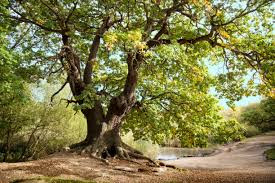
The history of the oak tree is rich with myth, legend and cultural significance.  The oak tree was sacred to many gods, including Zeus, Jupiter, Thor and the Celtic Dagda.   

The oaks association with lightening and thunder may have contributed to its sacred status.  The oak was a symbol of strength and endurance for many ancient cultures the the Druids, Greeks, Romans, Celts, Slavs and Vikings.

Since the earliest ties between humans and oaks a very symbolic image of oaks has developed in which these trees have become associated with longevity, stability, endurance, fertility, power, justice and honesty.

Oaks have been common to these islands since the end of the Ice Age, some 12,000 years ago.  An oak tree can grow over 30 metres tall.  In England the oak is a national symbol of strength.  Couples were wed under ancient oaks in Oliver Cromwell's time.

The oak tree holds a special place in Celtic mythology.  Ancient Celts believed that oak tree were portals to other worldly realms, and Druids held ceremonies in oak groves, associating the tree with spiritual significance.

                                                                                    *


From John Everett Millais   October 16th 1851 in Surrey

'Worked on my picture; painted nasturtiums; saw a stoat run into a  hole in the garden wall;   went up to it and endeavoured to lure the little beast out by mimicking a rat's or mouse's squeak.....Succeeded, to my astonishment.  He came half out of the hole and looked in my face, within easy reach.'


From Francis Kilvert    October 25th   1874 in Wiltshire

'A damp morning steaming with heat, the outer air like a hothouse, the inner air colder, and in consequence the old thick panelled walls of the front rooms streaming with the warm air condensed on the cod walls.....The afternoon was so gloomy that I was obliged for the first time to have lights in the pulpit.'

                                                                          *


I Call To You


I am the winter snow

the summer sun

I am the birdsong

the first snowdrop

I am the seagull's cry

the gold red sunset

I am the butterfly, the ladybird

the falling leaves

I am the blue mountains

the oak tree

I am whispering trees

the silver stream

I am the Southerly wind

the Northern Star

I am the sound of the sea

the gentle rain

I am the light, peace

love and sisterly soul


I call to you

                                                                        *


I wrote this poem at 3am in the morning, the words somehow dictated from above.


With very best wishes, Patricia